 Add to Chrome
 Add to Firefox
 Add to Edge
CausaLab: A Scalable Environment for Interactive Causal Discovery Toward AI Scientists
May 28, 2026
We introduce CausaLab, a scalable environment for evaluating interactive causal discovery by LLM agents. Unlike prior evaluations, CausaLab evaluates both whether an agent can solve a problem using causal evidence and whether its answer is grounded in a faithful recovered causal mechanism. Each episode places an agent in a synthetic laboratory: it receives prior measurement records, intervenes on a manipulator crystal, and predicts the resonance frequency of a held-out reactor crystal governed by the same mechanism. The hidden data-generating process is a randomly sampled structural causal model (SCM), so success requires recovering both a causal graph and structural equations rather than recalling prior knowledge. Experiments show a persistent gap between prediction and mechanism recovery: in the purely observational 6-node setting, GPT-5.2-high reaches 92% task accuracy but only 0.471 all-edge $F_1$. Mixed observation-intervention strategies improve structural fidelity, while pure intervention remains difficult even for strong agents. We identify premature stopping as a major weakness and show that consistency verification mitigates it. CausaLab therefore separates predictive success from causal understanding and exposes current LLM agents' limits as experimental causal reasoners.

GRASP: Plan-Guided Graph Retrieval with Adaptive Fusion and Reranking on Semi-Structured Knowledge Bases
May 28, 2026Semi-structured knowledge bases (SKBs) embed textual documents in a typed graph of entities and relations, and underpin applications such as product search, academic paper search, and precision-medicine inquiries. Existing hybrid retrieval systems on SKBs either use the graph only for query expansion, mix textual and structural branches under a global weighting, or rely on fine-tuned graph-traversal generators. We present GRASP, a three-stage SKB retrieval framework unifying plan-based graph retrieval, plan-conditioned fusion with a dense retriever, and a fine-tuned reranker over the fused candidates. GRASP substantially advances the state of the art on every metric across the three STaRK benchmarks, lifting average Hit@1 from 62.0 to 73.9. Ablation and sensitivity studies further confirm the effectiveness and robustness of GRASP.
MoRe: Modular Representations for Principled Continual Representation Learning on Squantial Data
May 14, 2026Continual learning requires models to adapt to new data while preserving previously acquired knowledge. At its core, this challenge can be viewed as principled one-step adaptation: incorporating new information with minimal interference to existing representations. Most existing approaches address this challenge by modifying model parameters or architectures in a supervised, task-specific manner. However, the underlying issue is representational: tasks require distinct yet structured representations that can be selectively updated without disrupting representations, while structure should reflect intrinsic organization in the data rather than task boundaries. In sequential data, time-delayed dependencies provide a natural signal for uncovering this organization, revealing how fundamental representations give rise to more specific ones. Inspired by the modular organization of the human brain, we propose MoRe, a framework that identifies modularity in the representation itself rather than allocating it at the architectural level. MoRe decomposes knowledge into a hierarchy of fundamental and specific modules with identifiability guarantees, enabling principled module reuse, alignment, and expansion during adaptation while preserving old modules by construction. Experiments on synthetic benchmarks and real-world LLM activations demonstrate interpretable hierarchical structure, improved plasticity-stability trade-offs, suggesting MoRe as a principled foundation for continual adaptation
Beyond the Black Box: Identifiable Interpretation and Control in Generative Models via Causal Minimality
Dec 11, 2025Deep generative models, while revolutionizing fields like image and text generation, largely operate as opaque black boxes, hindering human understanding, control, and alignment. While methods like sparse autoencoders (SAEs) show remarkable empirical success, they often lack theoretical guarantees, risking subjective insights. Our primary objective is to establish a principled foundation for interpretable generative models. We demonstrate that the principle of causal minimality -- favoring the simplest causal explanation -- can endow the latent representations of diffusion vision and autoregressive language models with clear causal interpretation and robust, component-wise identifiable control. We introduce a novel theoretical framework for hierarchical selection models, where higher-level concepts emerge from the constrained composition of lower-level variables, better capturing the complex dependencies in data generation. Under theoretically derived minimality conditions (manifesting as sparsity or compression constraints), we show that learned representations can be equivalent to the true latent variables of the data-generating process. Empirically, applying these constraints to leading generative models allows us to extract their innate hierarchical concept graphs, offering fresh insights into their internal knowledge organization. Furthermore, these causally grounded concepts serve as levers for fine-grained model steering, paving the way for transparent, reliable systems.
Multi-Scale Feature Fusion and Graph Neural Network Integration for Text Classification with Large Language Models
Nov 07, 2025This study investigates a hybrid method for text classification that integrates deep feature extraction from large language models, multi-scale fusion through feature pyramids, and structured modeling with graph neural networks to enhance performance in complex semantic contexts. First, the large language model captures contextual dependencies and deep semantic representations of the input text, providing a rich feature foundation for subsequent modeling. Then, based on multi-level feature representations, the feature pyramid mechanism effectively integrates semantic features of different scales, balancing global information and local details to construct hierarchical semantic expressions. Furthermore, the fused features are transformed into graph representations, and graph neural networks are employed to capture latent semantic relations and logical dependencies in the text, enabling comprehensive modeling of complex interactions among semantic units. On this basis, the readout and classification modules generate the final category predictions. The proposed method demonstrates significant advantages in robustness alignment experiments, outperforming existing models on ACC, F1-Score, AUC, and Precision, which verifies the effectiveness and stability of the framework. This study not only constructs an integrated framework that balances global and local information as well as semantics and structure, but also provides a new perspective for multi-scale feature fusion and structured semantic modeling in text classification tasks.
LLM-Centric RAG with Multi-Granular Indexing and Confidence Constraints
Oct 30, 2025This paper addresses the issues of insufficient coverage, unstable results, and limited reliability in retrieval-augmented generation under complex knowledge environments, and proposes a confidence control method that integrates multi-granularity memory indexing with uncertainty estimation. The method builds a hierarchical memory structure that divides knowledge representations into different levels of granularity, enabling dynamic indexing and retrieval from local details to global context, and thus establishing closer semantic connections between retrieval and generation. On this basis, an uncertainty estimation mechanism is introduced to explicitly constrain and filter low-confidence paths during the generation process, allowing the model to maintain information coverage while effectively suppressing noise and false content. The overall optimization objective consists of generation loss, entropy constraints, and variance regularization, forming a unified confidence control framework. In the experiments, comprehensive sensitivity tests and comparative analyses were designed, covering hyperparameters, environmental conditions, and data structures, to verify the stability and robustness of the proposed method across different scenarios. The results show that the method achieves superior performance over existing models in QA accuracy, retrieval recall, ranking quality, and factual consistency, demonstrating the effectiveness of combining multi-granularity indexing with confidence control. This study not only provides a new technical pathway for retrieval-augmented generation but also offers practical evidence for improving the reliability and controllability of large models in complex contexts.
Score-based Greedy Search for Structure Identification of Partially Observed Linear Causal Models
Oct 05, 2025Identifying the structure of a partially observed causal system is essential to various scientific fields. Recent advances have focused on constraint-based causal discovery to solve this problem, and yet in practice these methods often face challenges related to multiple testing and error propagation. These issues could be mitigated by a score-based method and thus it has raised great attention whether there exists a score-based greedy search method that can handle the partially observed scenario. In this work, we propose the first score-based greedy search method for the identification of structure involving latent variables with identifiability guarantees. Specifically, we propose Generalized N Factor Model and establish the global consistency: the true structure including latent variables can be identified up to the Markov equivalence class by using score. We then design Latent variable Greedy Equivalence Search (LGES), a greedy search algorithm for this class of model with well-defined operators, which search very efficiently over the graph space to find the optimal structure. Our experiments on both synthetic and real-life data validate the effectiveness of our method (code will be publicly available).
Step-Aware Policy Optimization for Reasoning in Diffusion Large Language Models
Oct 02, 2025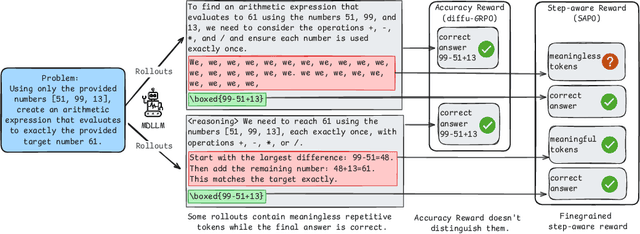
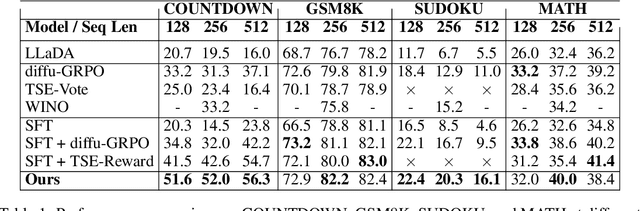
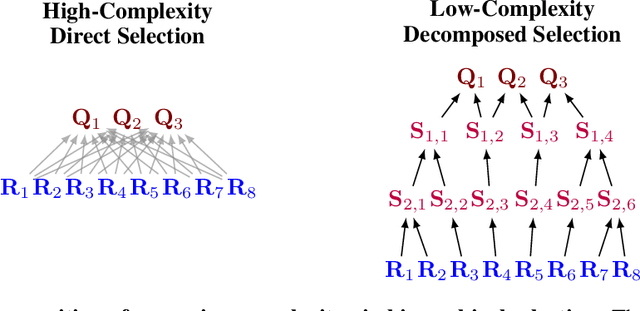
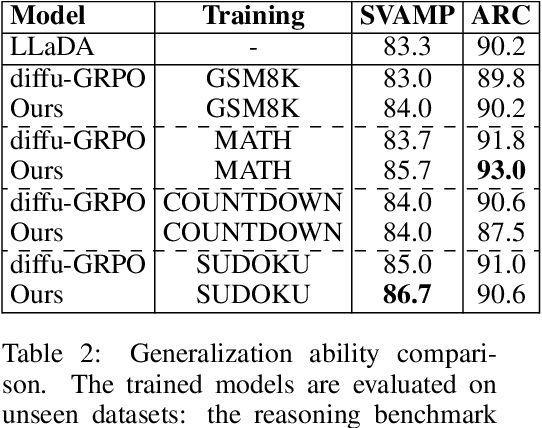
Diffusion language models (dLLMs) offer a promising, non-autoregressive paradigm for text generation, yet training them for complex reasoning remains a key challenge. Current reinforcement learning approaches often rely on sparse, outcome-based rewards, which can reinforce flawed reasoning paths that lead to coincidentally correct answers. We argue that this stems from a fundamental mismatch with the natural structure of reasoning. We first propose a theoretical framework that formalizes complex problem solving as a hierarchical selection process, where an intractable global constraint is decomposed into a series of simpler, localized logical steps. This framework provides a principled foundation for algorithm design, including theoretical insights into the identifiability of this latent reasoning structure. Motivated by this theory, we identify unstructured refinement -- a failure mode where a model's iterative steps do not contribute meaningfully to the solution -- as a core deficiency in existing methods. We then introduce Step-Aware Policy Optimization (SAPO), a novel RL algorithm that aligns the dLLM's denoising process with the latent reasoning hierarchy. By using a process-based reward function that encourages incremental progress, SAPO guides the model to learn structured, coherent reasoning paths. Our empirical results show that this principled approach significantly improves performance on challenging reasoning benchmarks and enhances the interpretability of the generation process.
Position: Mechanistic Interpretability Should Prioritize Feature Consistency in SAEs
May 26, 2025Sparse Autoencoders (SAEs) are a prominent tool in mechanistic interpretability (MI) for decomposing neural network activations into interpretable features. However, the aspiration to identify a canonical set of features is challenged by the observed inconsistency of learned SAE features across different training runs, undermining the reliability and efficiency of MI research. This position paper argues that mechanistic interpretability should prioritize feature consistency in SAEs -- the reliable convergence to equivalent feature sets across independent runs. We propose using the Pairwise Dictionary Mean Correlation Coefficient (PW-MCC) as a practical metric to operationalize consistency and demonstrate that high levels are achievable (0.80 for TopK SAEs on LLM activations) with appropriate architectural choices. Our contributions include detailing the benefits of prioritizing consistency; providing theoretical grounding and synthetic validation using a model organism, which verifies PW-MCC as a reliable proxy for ground-truth recovery; and extending these findings to real-world LLM data, where high feature consistency strongly correlates with the semantic similarity of learned feature explanations. We call for a community-wide shift towards systematically measuring feature consistency to foster robust cumulative progress in MI.
Reflection-Window Decoding: Text Generation with Selective Refinement
Feb 05, 2025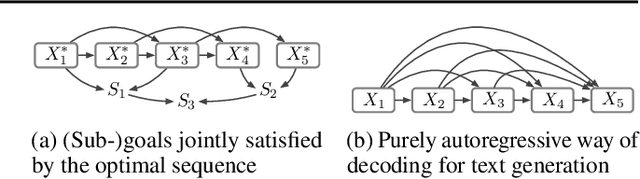



The autoregressive decoding for text generation in large language models (LLMs), while widely used, is inherently suboptimal due to the lack of a built-in mechanism to perform refinement and/or correction of the generated content. In this paper, we consider optimality in terms of the joint probability over the generated response, when jointly considering all tokens at the same time. We theoretically characterize the potential deviation of the autoregressively generated response from its globally optimal counterpart that is of the same length. Our analysis suggests that we need to be cautious when noticeable uncertainty arises during text generation, which may signal the sub-optimality of the generation history. To address the pitfall of autoregressive decoding for text generation, we propose an approach that incorporates a sliding reflection window and a pausing criterion, such that refinement and generation can be carried out interchangeably as the decoding proceeds. Our selective refinement framework strikes a balance between efficiency and optimality, and our extensive experimental results demonstrate the effectiveness of our approach.